METAL ROLL FORMING MACHINE
Zhongtuo roll forming Systems is a "one-stop shop" for all your roll forming needs,enabling our customers to save time and money when buying roll forming machines,to help customers grow.
Zhongtuo roll forming Systems is a "one-stop shop" for all your roll forming needs,enabling our customers to save time and money when buying roll forming machines,to help customers grow.
‹ › Walk into an older office building, a school corridor, or a hospital ward, and you will likely see it. A ceiling made of white square panels. That is a drop ceiling. It became a standard feature in modern buildings. Its popularity did not come from its looks. It came from solving a…
Contact: Elliot liu
Email: [email protected]
WhatsApp: 008615127728988
Detailed Content
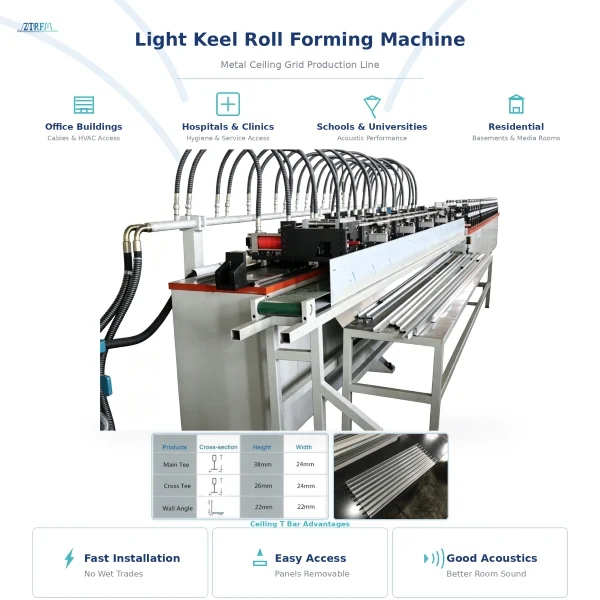
Walk into an older office building, a school corridor, or a hospital ward, and you will likely see it. A ceiling made of white square panels. That is a drop ceiling. It became a standard feature in modern buildings. Its popularity did not come from its looks. It came from solving a real problem. A light keel roll forming machine produces the metal framing that makes these ceilings practical.
Buildings used to leave ceilings as bare slab undersides. Pipes, ducts, and cables were all exposed. That was unsightly and made maintenance difficult. Drop ceilings solved this by creating a hidden cavity that remains accessible.
The value of a drop ceiling is the accessible cavity it creates. Between the slab and the ceiling panels, there is room for air conditioning ducts, power cables, fire sprinkler pipes, and data cables. These are hidden from view, giving the interior a clean, tidy appearance.
The real difference between a drop ceiling and other ceiling types is that it is not sealed shut. Any panel can be removed individually. Workers can access the cavity above by taking down one or a few panels. This means electrical, HVAC, and fire systems can be maintained or modified without damaging the finished ceiling.
The system offers several practical benefits:
Fast installation with no wet trades and no delays to other work
Relatively low cost with high material standardization
Easy integration of lights, sprinklers, and air vents
Good acoustic performance that improves room acoustics
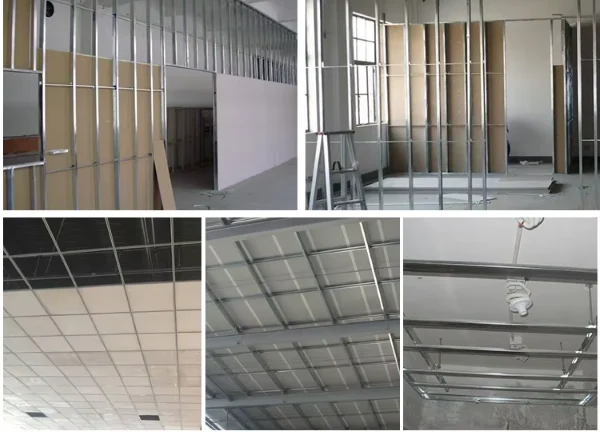
Drop ceilings are used in many building types where access to overhead services matters. A light keel roll forming machine produces the metal framing for these systems. Typical applications include:
Office buildings where cables and HVAC systems need regular access
Hospitals and clinics where hygiene and service access are critical
Schools and universities where acoustic performance matters
Residential basements and media rooms where homeowners want finished ceilings with service access
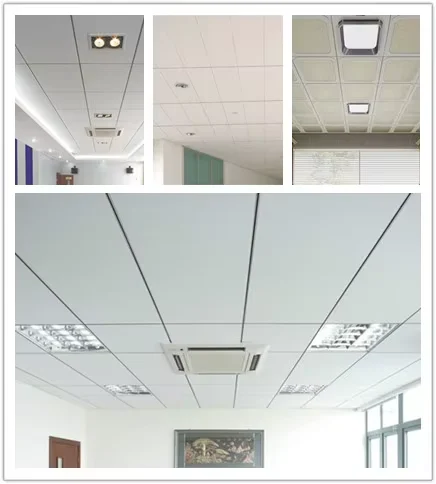
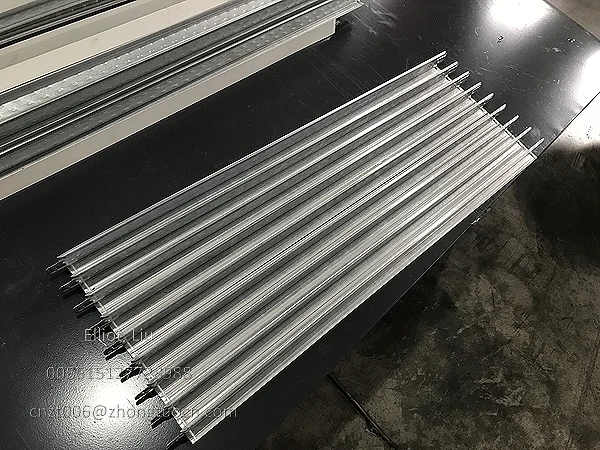
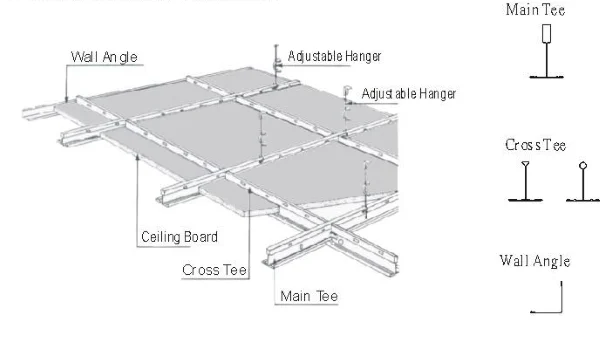
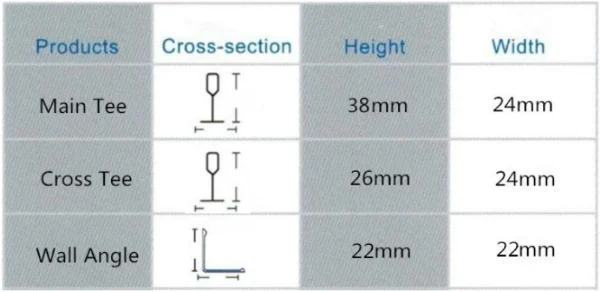
A standard drop ceiling system uses three types of metal profiles to form the supporting grid. These profiles work together to create the structure that holds the ceiling panels.
Main Tee is the load bearing frame. It hangs from the slab by suspension wires, running parallel along the room length. The main tee carries the weight of the ceiling and the panels.
Cross Tee runs perpendicular to the main tee. Its ends lock into slots on the main tee. The cross tee divides the space into standard sized grid units. In any ceiling system, the number of cross tees far exceeds main tees.
Wall Angle mounts on the surrounding walls at ceiling height. It supports the ceiling edges and provides a clean finish that covers the gap between wall and ceiling.
1. Continuous forming ensures consistent dimensions. The roll forming process of a light keel roll forming machine produces each profile to the same specifications, eliminating variations common in manual operations.
2. Integrated punching improves production flow. Punching stations are built into the production line of this equipment, so punching happens as part of the forming process.
3. Multiple lines run independently. The main tee, cross tee, and wall angle lines of a light keel roll forming machine operate separately, allowing flexible scheduling.
4. Dedicated roller sets maintain profile accuracy. Each line uses rollers designed for its specific profile shape, ensuring consistent cross sections.
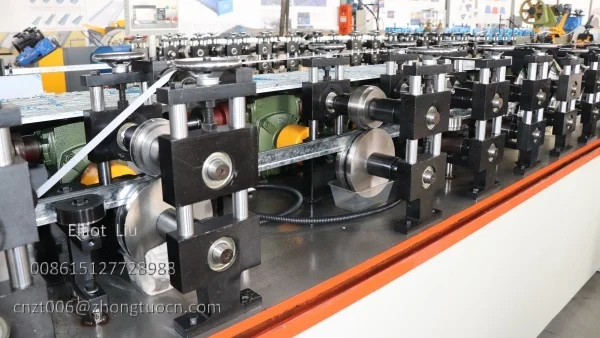
A medium sized commercial project often needs thousands of main tees and cross tees, plus wall angles to match. These profiles must fit together precisely. Cross tees need to lock into main tees smoothly. Wall angles need to sit flat against walls.
If different batches vary in size, problems appear on site. Clips do not lock, grids become uneven, and panels do not sit properly. This slows down installation and can cause rework. For bulk supply, consistent sizing and reliable delivery are equally important. A suspended ceiling T bar forming machine is built to handle this level of consistent output.
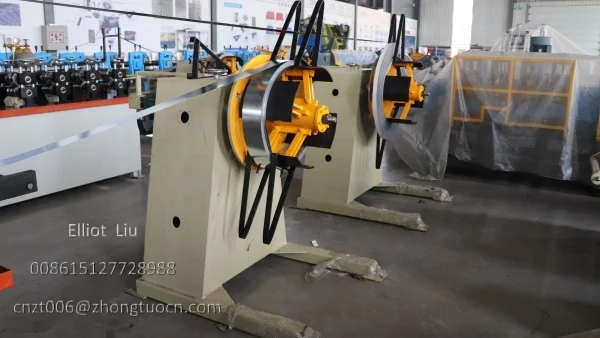
Main tees, cross tees, and wall angles all belong to the same ceiling system. But their cross sections are different, and their production requirements differ too. Main tees have a larger section. Cross tees are smaller but needed in the largest quantity. Wall angles have an L shaped section and require consistent straightness.
These profiles are produced on three independent lines. Each line of a light keel roll forming machine has its own roller set designed for a specific profile shape. Running three independent lines offers flexibility: you can schedule production based on order demand, and changing one profile does not affect the others.
Main tee line: produces main tees
Cross tee line: produces cross tees
Wall angle line: produces wall angles
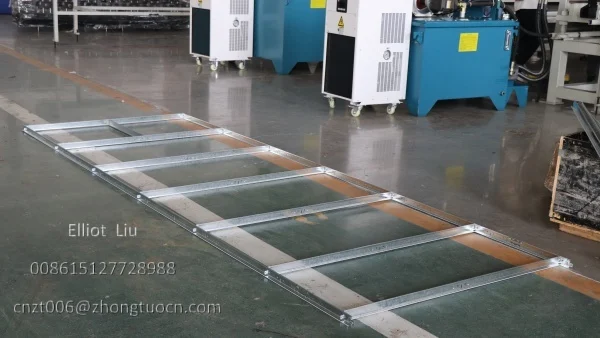
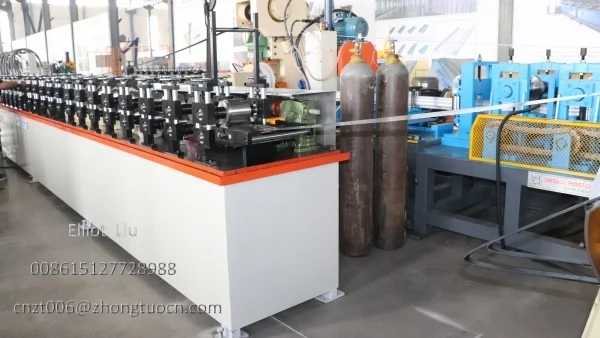
Bulk production of ceiling components needs a continuous and stable forming process. The light keel roll forming machine is designed for this purpose.
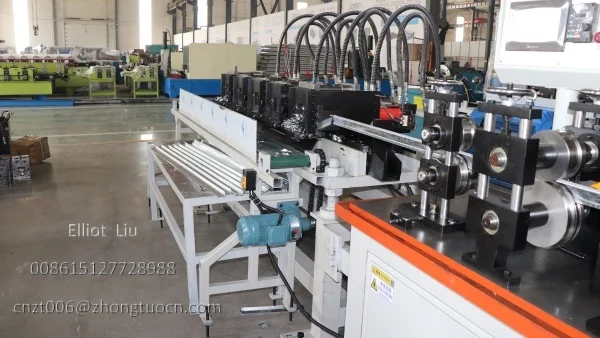
This equipment uses multiple roller stations to cold form steel strip into shape. The cross sections of main tees, cross tees, and wall angles are all different. By using different roller sets on each line, the equipment produces different profiles. During operation, the strip feeds continuously through forming, punching, and cutting to deliver finished products.
The equipment serves the production of these components by:
Running continuously to maintain consistent output
Applying progressive forming to achieve accurate cross sections
Integrating punching operations to reduce handling
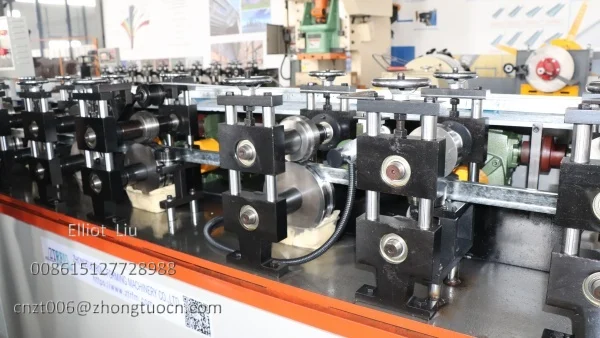
With a suspended ceiling T grid forming machine, manufacturers can produce all three profile types without investing in separate equipment for each.
The table below shows the main specifications for the three production lines of a light keel roll forming machine.
| Parameter | Main Tee Line | Cross Tee Line | Wall Angle Line |
|---|---|---|---|
| Forming Steps | 18 steps | 16 steps | 8 roller sets |
| Forming Speed | Up to 25 m/min | Up to 25 m/min | Up to 40 m/min |
| Main Motor | 4 kw | 4 kw | 3.0 kw |
| Hydraulic Power Unit | — | 7.5 kw | 3 kw |
| Servo Motor | 1.2 kw | — | — |
| Voltage | 380 v 50 hz 3 phase | 380 v 50 hz 3 phase | 380 v 50 hz 3 phase |
| Roller Material | Cr12 with quenched treatment | Cr12 with quenched treatment | GCr12 |
| Shaft Material | 45# steel with quenched treatment | 45# steel with quenched treatment | 45# steel with tempering |
| Decoiler | ID 450‑550 mm, capacity 1.5 T | ID 450‑550 mm, capacity 1.5 T | ID 450‑550 mm, capacity 1.5 T |
| Length Tolerance | 3 m +1.5 mm | 3 m +1.5 mm | 3 m ±1.0 mm |
Drop ceilings became a common solution in commercial and public buildings because they solved a real problem: hiding services while keeping them accessible. As this ceiling type became more widely adopted, demand for main tees, cross tees, and wall angles grew steadily.
These components are highly standardized. Different projects may use different sizes, but within a single project, dimensional consistency is critical. Continuous roll forming, powered by a light keel roll forming machine, meets this bulk supply requirement while maintaining stable dimensions over long production runs.
Drop ceilings earned their place in modern construction because they deliver on that goal, and the light keel roll forming machine that produces their components makes that possible at scale.
Contact: Elliot liu
Email: [email protected]
WhatsApp: 008615127728988
Contact Us For More Roll Forming Machine Detailed Information
You can contact us either through phone number 0086-15127728988 within our working hours, or send an email to [email protected], or send an inquiry form to us using "Inquiry Now" option. Our customer representatives will respond as soon as possible.