METAL ROLL FORMING MACHINE
Zhongtuo roll forming Systems is a "one-stop shop" for all your roll forming needs,enabling our customers to save time and money when buying roll forming machines,to help customers grow.

Zhongtuo roll forming Systems is a "one-stop shop" for all your roll forming needs,enabling our customers to save time and money when buying roll forming machines,to help customers grow.
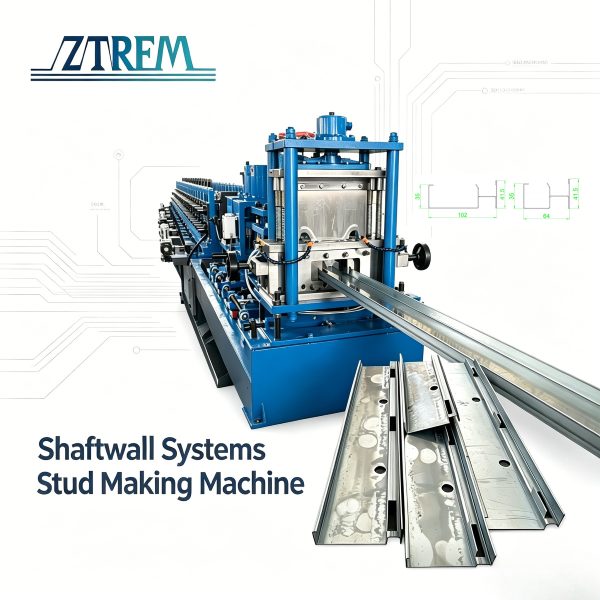
This machine delivers high precision CT studs for elevator shaft walls, stairwells, and equipment chases. Elevator shaft walls require exceptional accuracy; the vertical deviation across the full shaf...
Contact: Elliot liu
Email: [email protected]
WhatsApp: 008615127728988
Detailed Content
This machine delivers high precision CT studs for elevator shaft walls, stairwells, and equipment chases. Elevator shaft walls require exceptional accuracy; the vertical deviation across the full shaft height must not exceed one thousandth of the total height. Every single CT stud's dimensional precision determines whether the entire wall system meets these stringent standards.
For plants running theShaftwall Systems Stud Making Machine, the payoff is straightforward. Contractors can install every stud directly into the J Track without trimming ends, deburring cut surfaces, or straightening bent profiles. That means fewer customer complaints, faster project completion, and a stronger reputation for quality.
Elevator shaft enclosure systems impose stricter accuracy requirements on CT studs than standard partition walls. Three factors matter most.
Length accuracy
CT studs fit between top and bottom J Tracks using friction fit. If the length deviates too much, the stud won't stay in place or won't fit at all. An elevator shaft dozens of meters high uses hundreds of studs; one inaccurate piece affects the entire wall's verticality.
Cut face quality
The stud's end face contacts the J Track's bottom surface directly. Burrs or deformation on the cut face compromise the fit. Burrs can also scratch the track's galvanized coating and accelerate corrosion.
Straightness
Any bending or twisting along the stud's length transfers to the whole shaft wall system. Elevator guide rails demand strict verticality limits per meter. Every stud must remain straight.


The Shaftwall Systems Stud Making Machine produces CT studs for these building applications.
CT studs work with J Tracks. Gypsum shaft liners fit between the stud flanges to form a complete enclosure. The entire system installs from the shaft exterior; workers don't need access inside the shaft.

| Item | Specification |
|---|---|
| Material | Galvanized steel coil |
| Material thickness | 0.8–1.2mm (commonly 0.9mm) |
| Material yield strength | ≤350 MPa |
| Uncoiler capacity | 3 tons |
| Coil ID | 450–550mm |
| Coil max OD | 1300mm |
| Leveling rollers | 7 rollers (3 top, 4 bottom) |
| Forming passes | 32 passes |
| Spindle material | 45# steel |
| Spindle diameter | 50mm |
| Spindle precision | 0.02mm |
| Forming roller hardness | HRC55–58 |
| Punching die hardness | HRC60–62 |
| Production speed | 4–6 m/min |
| Available sizes | 3 web heights (adjustable spacing) |
| Cutting length tolerance | ≤0.3mm (for lengths under 1000mm) |
| Profile camber/warp/twist | ≤0.4mm/m |
| Cut burr height | ≤0.20mm |
| Total power | Approximately 35kW |
| Main forming motor power | 22kW |
| Power supply | 480V, 60Hz, 3 phase, 4 wire |
| Ambient temperature | -10°C to 40°C |
| Ambient humidity | ≤90% (at 25°C) |

The line starts with a passive decoiler that holds the galvanized coil and supplies steady unwinding tension.
The strip enters a precision leveler with a 7 roller system (3 top, 4 bottom). This removes internal stresses formed during coiling.
The leveled strip moves to the punching stations and the main forming machine. The punching stations create mounting holes at preset locations. The main forming machine uses 32 precision roller passes to gradually roll the flat strip into the CT stud's final profile.
A hydraulic cut off device at the line's end performs length cutting while the line runs continuously.
The entire line runs from coil feeding to finished stud discharge without interruption. Each unit's speed and timing are matched before delivery. This ensures stable long term operation and prevents stops or scrap from mismatched sections.

Cutting is the final step on the CT stud line. It determines whether the finished stud meets elevator shaft installation requirements.
The Shaftwall Systems Stud Making Machine uses a hydraulic cutting device with fiber optic positioning and synchronized cutting. It performs cuts without stopping the production line.
Length control
Cutting length tolerance stays within 0.3mm (for lengths under 1000mm). Hundreds of studs in a high rise elevator shaft maintain consistent length. On site installation requires no measuring or trimming.
Cut face quality
Cut burrs stay under 0.20mm. Cold formed products often deform at the cut end due to stress release. This machine's cutting dies use high grade alloy tool steel with heat treatment. The cut face comes out clean and smooth. No burrs, no tearing. The CT stud fits tightly against the J Track and won't scratch the track's galvanized coating.

The CT stud profile has multiple bends. Its forming follows the basic principle of cold roll forming, gradually shaping the metal through multiple passes instead of forming everything in one stroke.
The Shaftwall Systems Stud Making Machine uses 32 forming passes. Each pass applies a small bending angle. The total shape accumulates progressively.
This gradual approach controls elastic springback effectively. It avoids internal stress concentration. The finished profile stays straight within 0.4mm/m for camber, warp, and twist. Every CT stud remains straight in a shaft dozens of meters high, ensuring the entire wall stays vertical.

Long term cutting precision depends on component durability.
The forming rollers and punching dies use Cr12MoV/D2 high grade alloy tool steel. The rollers undergo vacuum heat treatment and double tempering, reaching HRC55–58 surface hardness. The dies also receive vacuum heat treatment, reaching HRC60–62.
Under prolonged high pressure friction and impact against galvanized steel, these components hold their profile. The machine won't develop larger burrs or wider length tolerances from wear. You won't need frequent die changes or repeated recalibration. Cut quality remains consistent batch after batch.

Contact: Elliot liu
Email: [email protected]
WhatsApp: 008615127728988
Contact Us For More Roll Forming Machine Detailed Information
You can contact us either through phone number 0086-15127728988 within our working hours, or send an email to [email protected], or send an inquiry form to us using "Inquiry Now" option. Our customer representatives will respond as soon as possible.