METAL ROLL FORMING MACHINE
Zhongtuo roll forming Systems is a "one-stop shop" for all your roll forming needs,enabling our customers to save time and money when buying roll forming machines,to help customers grow.

Zhongtuo roll forming Systems is a "one-stop shop" for all your roll forming needs,enabling our customers to save time and money when buying roll forming machines,to help customers grow.
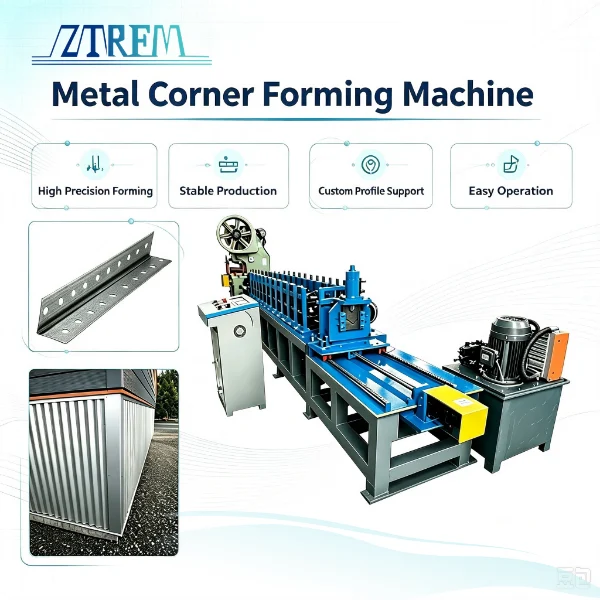
‹ › Buying a metal corner forming machine is a big decision. You have likely received multiple quotes with spec sheets full of numbers that are hard to compare. The same type of machine can vary in price by a wide margin. The challenge is knowing which specs actually affect your production and which ones are…
Contact: Elliot liu
Email: [email protected]
WhatsApp: 008615127728988
Detailed Content
Buying a metal corner forming machine is a big decision. You have likely received multiple quotes with spec sheets full of numbers that are hard to compare. The same type of machine can vary in price by a wide margin. The challenge is knowing which specs actually affect your production and which ones are just numbers. This guide walks through eight critical parameters you must check, explaining why each one matters, how to compare them, and what to confirm with suppliers.
Before looking at specs, you need to understand what this equipment produces and how that affects your choice.
A metal corner forming machine turns steel coil into L shaped corner bead or angle profiles. It integrates decoiling, punching, roll forming, and hydraulic cutting into one continuous process.
The finished products are L shaped corner beads, used in several fields:
Drywall and plasterboard systems
Metal cladding and wall panel systems
Electrical and switchgear manufacturing
Racking and storage equipment
Modular and prefabricated construction
Different applications have different equipment needs:
Drywall or plasterboard: thin material (0.3–0.6mm), high speed, inline punching
Electrical cabinets or switchgear: moderate thickness, high precision, stable batches
Building cladding or metal facades: surface quality focus, diverse material types
Your product application determines what machine configuration you need.
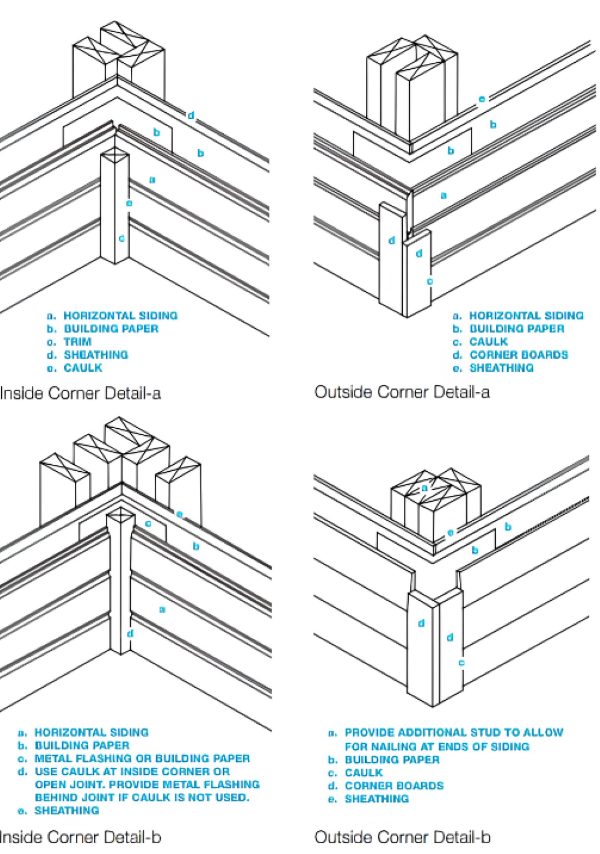
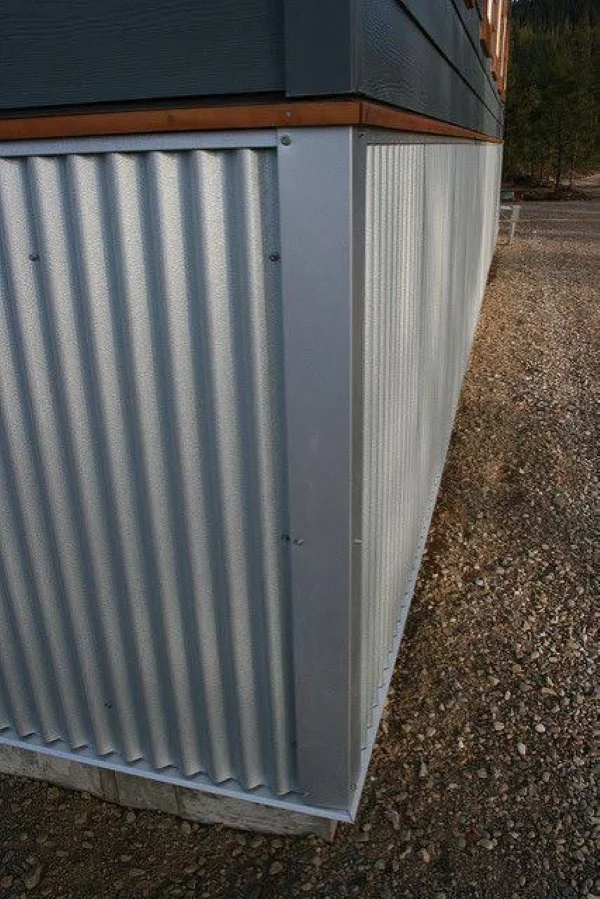
Before diving into specific parameters, it helps to understand what this machine can do for your production. These advantages focus on the equipment itself, not the finished product.
Continuous production that reduces handling
The equipment integrates decoiling, punching, forming, and cutting in one line. Coil goes in and finished profiles come out the other end.
Inline punching that eliminates secondary operations
Punching happens at the same time as forming. Products that need holes come out fully finished in one pass.
High speed continuous forming for better output
Roll forming is a continuous process. The strip moves through each roller station without stopping, bending gradually into its final shape.
Automated operation with less manual labor
The whole line runs automatically from decoiling to cutting, with a control system coordinating each station.
One main machine, multiple profile sizes
The same main machine can run several different corner profile sizes by changing the punching, forming, and cutting tool sets.
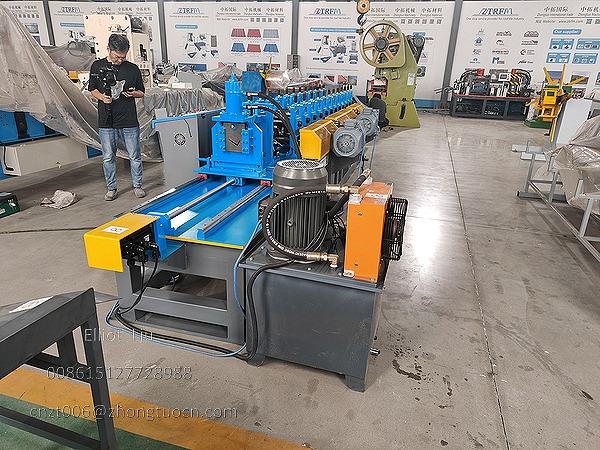
The following eight parameters are critical points to evaluate when assessing a metal corner forming machine.
What to check
Confirm that the machine's thickness range covers your product thickness. A typical configuration handles 0.3–0.6mm for galvanized steel. Check whether the range covers both your minimum and maximum thickness.
Why it matters
If the range does not cover your product thickness, the equipment cannot do the job.
What to confirm with the supplier
Can this machine run stably at maximum thickness? Are the frame and shaft diameter designed for the upper thickness limit?
What to check
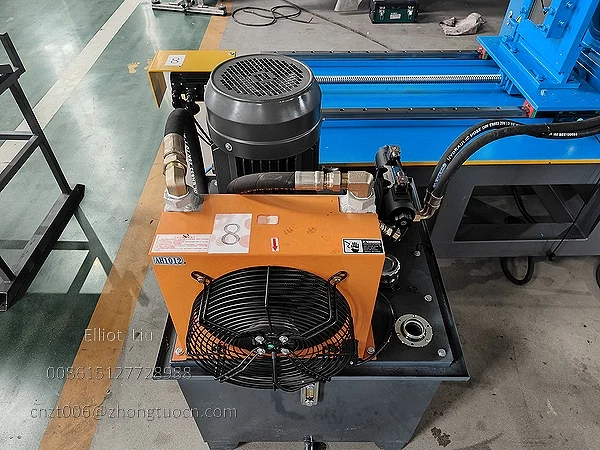
Speed determines output. But speed with punching and without punching are different. A typical configuration shows 0–15m/min with punching and 0–40m/min without punching.
Why it matters
The speed gap shows how punching affects throughput. If your product needs inline punching, the lower speed is your actual production ceiling.
What to confirm with the supplier
What are the speeds with and without punching? Is the speed adjustable?
What to check
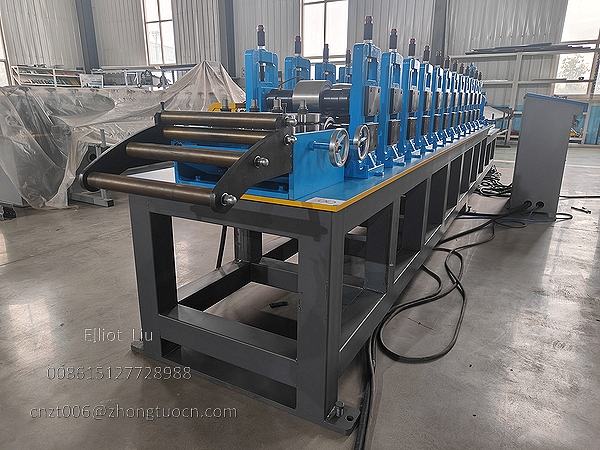
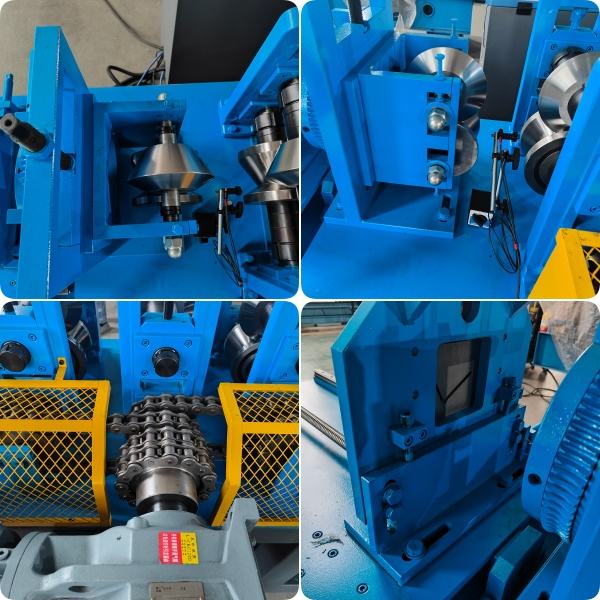
The number of roller stations determines how gradually the angle is formed. A typical configuration uses 11 rollers.
Why it matters
Too few stations means each bend is sharper, which may cause edge waves or springback. Too many stations means a longer machine and higher cost.
What to confirm with the supplier
What is the angle distribution plan for these stations? Can you provide a roller chart?
What to check
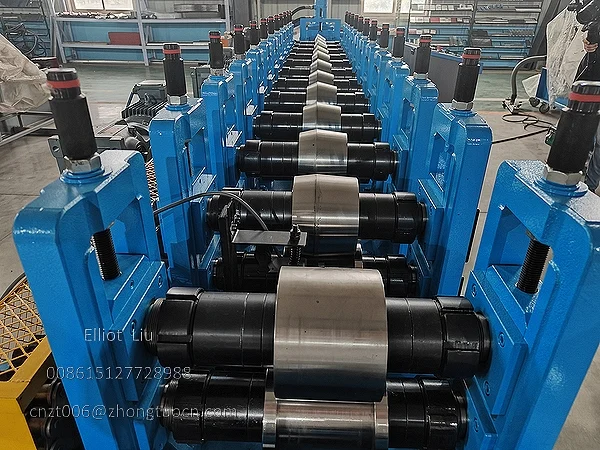
Roller material affects service life and finished surface quality. A common specification uses Cr12MoV, a cold work tool steel with good wear resistance.
Why it matters
Different materials and heat treatments affect how long rollers hold their shape and surface finish.
What to confirm with the supplier
What is the roller material? What is the heat treatment hardness? Is the surface hard chrome plated?
What to check
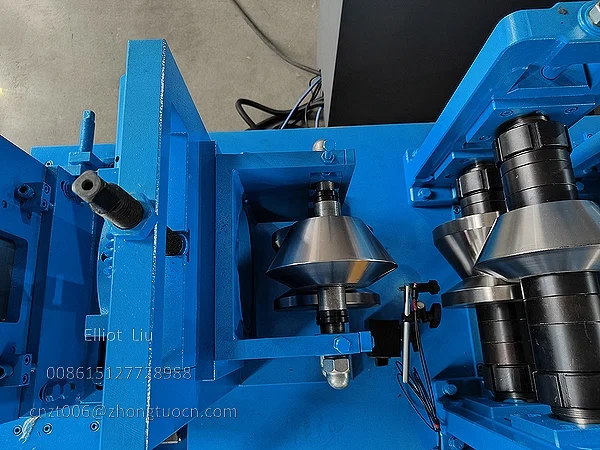
Shaft diameter affects machine rigidity. A typical configuration uses φ50mm shafts.
Why it matters
Shaft rigidity influences dimensional consistency across the profile width.
What to confirm with the supplier
What is the shaft material? Has it been tempered? What bearings support the shaft ends?
What to check
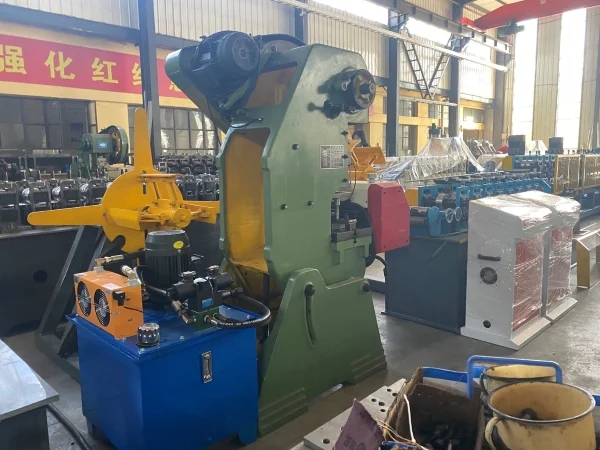
Whether you need inline punching affects equipment configuration and output. A typical mechanical punch press runs at 0–50 times per minute. The quoted press is rated at 16 tons with a nominal capacity of 1000 kN.
Why it matters
With punching active, line speed is lower. If your product does not need holes, you can choose a configuration without a corner punching machine and achieve higher speed.
What to confirm with the supplier
Is punching done before or after forming? What is the punching position accuracy? How long does it take to change punching tools?
What to check
Voltage and frequency must match your facility. A typical configuration uses 480V 60Hz 3Phase.
Why it matters
Mismatch means the machine cannot start up at your facility.
What to confirm with the supplier
Does the equipment support the voltage and frequency in my country? If not, can it be customized?
What to check
The same main machine can produce multiple corner profiles by changing the punching, forming, and cutting dies. A typical configuration supports up to 5 different profiles.
Why it matters
Changeover capability determines whether you need multiple machines for different profiles.
What to confirm with the supplier
How long does each changeover take? What is the tooling cost per profile? Does the machine need recalibration after a changeover?
The following table compiles typical parameters for reference:
| Parameter | Typical Reference Value | What to Consider |
|---|---|---|
| Material thickness | 0.3–0.6 mm | Check if it covers your product range |
| Material type | Galvanized steel | Different materials affect roller wear |
| Max coil width | 300 mm | Sets maximum profile width |
| Decoiler capacity | 3000 kg | Affects how often you change coils |
| Coil inner diameter | 450–550 mm | Must match your coil handling equipment |
| Forming speed with punching | 0–15 m/min | Output when punching is active |
| Forming speed without punching | 0–40 m/min | Output when punching is not active |
| Number of forming stations | 11 roller stations | More stations improve precision |
| Roller material | Cr12MoV | Affects service life and surface quality |
| Shaft diameter | φ50 mm | Related to machine rigidity |
| Shaft material | 45# steel with tempering | Affects shaft strength |
| Main machine size | 4500×800×1400 mm | Floor space requirement |
| Main machine weight | 3.0 tons | Foundation and lifting needs |
| Decoiler feeding | With motor feeder | Smoother feeding reduces strip issues |
| Punch press type | Mechanical, 16T / 1000 kN | Affects punching capacity |
| Punching speed | 0–50 times/min | Punching cycle frequency |
| Main drive power | 5.5 kW | Forming power capacity |
| Hydraulic cutting power | 5.5 kW | Cutting force capacity |
| Profile changeover | Up to 5 profiles | Flexibility for multiple products |
| Voltage / frequency | 480V 60Hz 3Phase | Must match your facility power |
A machine's parameters are interconnected. Thickness affects shaft diameter needs. Speed is influenced by punching. Roller material affects long term maintenance. When evaluating a metal corner forming machine, check whether these parameters support each other under a consistent design logic.
When you get a quote, put all eight parameters into one table and ask yourself: is this configuration overkill, insufficient, or just right for my needs? Use your product requirements as the benchmark.
When comparing multiple suppliers, make a simple comparison table with these eight parameters side by side. When one supplier's number stands out as unusually high or low, ask why. This moves your evaluation from price comparison to configuration comparison.
Contact: Elliot liu
Email: [email protected]
WhatsApp: 008615127728988
Contact Us For More Roll Forming Machine Detailed Information
You can contact us either through phone number 0086-15127728988 within our working hours, or send an email to [email protected], or send an inquiry form to us using "Inquiry Now" option. Our customer representatives will respond as soon as possible.