METAL ROLL FORMING MACHINE
Zhongtuo roll forming Systems is a "one-stop shop" for all your roll forming needs,enabling our customers to save time and money when buying roll forming machines,to help customers grow.
Zhongtuo roll forming Systems is a "one-stop shop" for all your roll forming needs,enabling our customers to save time and money when buying roll forming machines,to help customers grow.
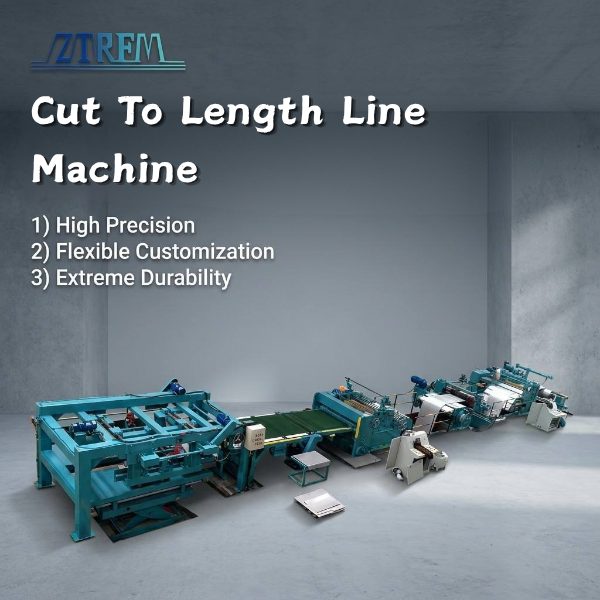
This cut to length line machine integrates uncoiling, leveling, shearing, and stacking into one automated system. It processes steel coils into flat sheets at speeds up to 60 m/min and delivers consistent quality with reduced labor.
Contact: Elliot liu
Email: [email protected]
WhatsApp: 008615127728988
Detailed Content
In sheet metal processing, one process runs through the entire chain from raw material to finished product. That process is cut to length. Whether for steel structure buildings, storage racking, solar mounting systems, or automotive parts, almost every metal product starts with uncoiling, leveling, and shearing a steel coil.
Acut to length line machineperforms exactly this task. It uncoils hot rolled or cold rolled steel, flattens the strip, and cuts it to precise lengths. The result is flat, dimensionally accurate sheets ready for downstream fabrication.
The fully automatic high speed cut to length line machine we introduce today brings together 14 process steps in one integrated system. From coil loading to finished sheet stacking, the entire operation runs continuously without manual intervention.
If you are looking for a cut to length solution that boosts throughput, stabilizes quality, and reduces labor dependency, the following sections are worth your time.
What Can This Equipment Produce?
The cut to length line machine processes steel coils into flat sheets at specified lengths. These sheets then move to roll forming, stamping, or bending operations to become industrial products we see every day.
Primary finished products include:
•Steel structure purlins, decking, and wall panels for buildings
•Uprights, beams, and shelves for storage racking systems
•Rails, posts, and connectors for solar mounting structures
•Troughs and covers for cable tray systems
•Truck floor panels and stamping blanks for automotive parts
•Light gauge steel framing, rolling shutter doors, and equipment housings
These products are widely used in:
•Steel frameworks for industrial plants and logistics warehouses
•Racking systems for ecommerce fulfillment centers
•Ground mount and rooftop solar array support structures
•Power and communication cable management systems
•Commercial vehicle body manufacturing
•Light gauge steel partition systems in residential construction
One cut to length line machine serving multiple industries, that is the investment value of a wide width leveling and shearing solution.


The table below lists the key technical parameters of this cut to length line machine.
| Parameter | Specification |
|---|---|
| Control type | PLC DC control |
| Material application | Carbon steel, CR, GI (black coils not included) |
| Thickness range | 0.5~3.5mm |
| Width range | 500~1830mm |
| Coil ID | Φ508/610/760mm |
| Coil OD | ≤Φ2000mm |
| Coil weight | ≤25 tons |
| Leveling roller diameter | Φ85mm |
| Number of leveling rollers | 17 pieces |
| Number of pinch rollers | 2 pieces |
| Leveling roller material | GCr15 |
| Shear blade material | LD |
| Line speed | ≤60 m/min |
These numbers define the machine's processing boundaries. The thickness limit is 3.5mm. The width limit is 1830mm. The maximum coil weight is 25 tons. Understanding these boundaries is the first step in determining whether this equipment matches your production requirements.
A cut to length line consists of 14 component units. But customers care about one thing only. How long does it take for my coil to become qualified sheets?
Let's walk through the production flow and see how this cut to length line machine turns a 25 ton coil into precisely cut sheets, step by step.

Operators lift the steel coil onto the hydraulic entry coil car. The car lifts and lowers via hydraulic cylinders and moves horizontally with a motor drive. It positions the coil precisely onto the uncoiler's expanding mandrel.
The coil car handles loads up to 25 tons. Even large diameter, heavy weight coils move smoothly into position.
The double head decoiler uses two separate heads that work together to support a single steel coil. The bidirectional hydraulic clamping structure holds the coil firmly from both sides. This design increases the load capacity and width adaptability of the uncoiling station.
The decoiler includes a braking mechanism and a three step tapered cone uncoiling head. These components ensure smooth, controlled pay off. The coil remains securely supported throughout the uncoiling process.

After uncoiling, the strip enters the leveling machine. This is the core station of the entire line. Sheet flatness directly determines the quality of every downstream process.
The leveling machine consists of 17 work rollers, 4 groups of backup rollers, and 2 pinch rollers. That makes 19 rollers total, each with a diameter of 85mm. All rollers are driven, making them active power rollers. A 110KW DC motor supplies the driving force.
The four fold design distributes force evenly across the work rollers and reduces wear. The entry side includes a hydraulic driven press plate and pinch device that guides the strip correctly into the leveling zone.

A speed difference exists between the leveling machine and the downstream precision straightening and shearing equipment. The loop resolves this issue.
During startup, hydraulic cylinders lift the transition plates to guide the strip head through. During normal operation, the transition plates lower. The strip drops into the pit through the curved transition surface.
Photoelectric sensors inside the pit monitor the stored strip quantity and automatically adjust the speed. When storage runs low, the front section speeds up. When storage builds up, the front section slows down. The system maintains dynamic balance continuously, ensuring uninterrupted production.
After exiting the pit, the strip first passes through the side guide device. Each side has a set of vertical edging rollers, 6 rollers total. Lead screws adjust the width from 500mm to 1830mm. The vertical rollers keep the strip on the correct path and prevent wandering.
The strip then enters the servo precision straightening machine. This unit features a 22kW servo motor that drives the feed rollers through a precision gearbox and synchronous belt drive.
The straightening unit uses a five roller configuration with 2 rollers on top and 3 on the bottom. This arrangement performs final positioning and micro leveling of the sheet. The servo motor delivers high precision length control. Every sheet length is precisely calculated and driven by the servo system with minimal error.
This unit also integrates a film application device and an inkjet printing device. The film protects the sheet surface from scratches. The inkjet printer marks each sheet with a "digital ID" including batch number, specification, and production date.

After precision positioning, the strip enters the shear. The shear blades use LD alloy steel. After heat treatment, they safely cut 3.5mm thick steel plate.
The blades feature a four side design. One blade body has four usable cutting edges. When one edge dulls, a 90 degree rotation brings a fresh edge into service. This design delivers four times the service life of conventional single edge blades.
The shearing action is a guillotine type cut from bottom to top. The shear works in sync with the feeder's signals and performs automatic cutting. The shear coordinates seamlessly with the servo length measurement system, achieving high speed synchronized shearing.

Cut sheets exit through the transportation table. The belt uses high tension fiber construction that is skid resistant and wear resistant. A 4KW variable speed motor drives the conveyor.
Sheets move onto the hydraulic lifting table. This table handles sheet lengths from 1000mm to 4000mm and widths from 500mm to 1830mm. As sheets stack one by one, the table gradually lowers to maintain a consistent picking height.
The pneumatic stacker operates under PLC control and performs automatic stacking. Three 0.75KW motors adjust the stacking width and length.

The stacked sheets move out of the production line via the exit coil car. The car works with the hydraulic lifting table, running on rails with motor drive. It transports the entire stack to the end of the line for packaging and transport.
At this point, a 25 ton steel coil has become neatly stacked, precisely cut sheets. One operator monitors the entire process from the control console.
With the production flow explained, let's focus on several key technical features that determine equipment performance and service life.
The logic behind the four fold leveling design is straightforward. The work rollers perform the leveling. The backup rollers protect the work rollers.
On two fold leveling machines without backup rollers, the work rollers bend and deflect under the reactive force from the strip. This causes uneven leveling and accelerated roller wear. The four fold design uses 4 groups of backup rollers to support the work rollers firmly. Force distributes evenly across the roller face.
The results are flatter sheets, longer roller life, and less frequent maintenance.

The work rollers use GCr15 bearing steel, forged construction. Surface hardness reaches HRC55-60 with a hardened depth of 3-5mm.
The backup rollers use 42Cr alloy steel, also forged. Surface hardness reaches HRC52-56 with a hardened depth of 3-5mm.
GCr15 is the standard steel for bearing manufacturing. It offers excellent wear resistance and contact fatigue strength. 42Cr is an alloy structural steel with high strength and good toughness. The combination of these two materials, along with the complete processing chain from forging and tempering to rough machining, hardening, finishing, and grinding, ensures that the rollers maintain precision and service life under high intensity continuous operation.
Forged structures are denser and mechanically superior to cast structures. The four fold backup roller design reduces work roller wear. The frame uses Q235 steel with welded construction and overall aging treatment to eliminate welding stress. Investing in quality where customers cannot see it, that is what determines whether a machine lasts ten or fifteen years.
The control system is the brain of the cut to length line machine. This equipment uses a Siemens PLC as the core controller. The touch screen is also Siemens branded.
Operators perform all settings on the touch screen. These include length setting, speed adjustment, automatic counting, and more. The system includes fault alarm functionality. When an abnormality occurs, the system alerts the operator for rapid troubleshooting.
On the execution side, the precision straightening unit uses a 22kW servo motor from Huichuan. The DC controller is a 590C unit. The servo system's high precision positioning capability provides the fundamental guarantee for accurate length cutting.

The shear blades use LD alloy steel.
LD is a high toughness cold work tool steel. It is specifically designed for impact loaded applications. The four side design gives each blade body four usable cutting edges. When one edge dulls, a 90 degree rotation brings a fresh edge into service.
The result is a 75% reduction in blade change frequency and significantly less downtime for blade replacement.
The entire production line, from coil loading to finished sheet discharge, operates automatically. One operator at the control console monitors the entire process. Compared to traditional lines that require multiple operators at different stations, labor demand drops substantially.

The line runs at 60 meters per minute. The double head decoiler provides stable coil support and rapid changeover capability. The line runs continuously for extended periods. The photoelectric control system in the loop eliminates speed mismatches between upstream and downstream stations, preventing stops caused by speed imbalance.
The combination of 17 roller four fold leveling and servo precision straightening delivers double assurance on sheet flatness and dimensional accuracy. The material advantages of GCr15 high hardness rollers and LD alloy steel blades ensure that precision holds up over long term operation.

Long equipment life and low consumable replacement frequency, these are the hidden value delivered by material selection and processing quality. GCr15 rollers, 42Cr backup rollers, LD blades, every wear part uses a higher grade material. Initial cost may be slightly higher, but total lifecycle cost is significantly lower.
From a 25 ton steel coil to precisely cut sheets, this cut to length line machine uses 14 subsystems, 19 rollers, 22kW servo drive, and Siemens PLC control to perform a process that appears simple but is precisely engineered.
If you are evaluating cut to length equipment options, or if you expect higher efficiency and quality from your existing line, this equipment deserves your serious consideration.
Ready to upgrade your production line? Let's talk.
Contact: Elliot liu
Email: [email protected]
WhatsApp: 008615127728988
Contact Us For More Roll Forming Machine Detailed Information
You can contact us either through phone number 0086-15127728988 within our working hours, or send an email to [email protected], or send an inquiry form to us using "Inquiry Now" option. Our customer representatives will respond as soon as possible.