METAL ROLL FORMING MACHINE
Zhongtuo roll forming Systems is a "one-stop shop" for all your roll forming needs,enabling our customers to save time and money when buying roll forming machines,to help customers grow.

Zhongtuo roll forming Systems is a "one-stop shop" for all your roll forming needs,enabling our customers to save time and money when buying roll forming machines,to help customers grow.
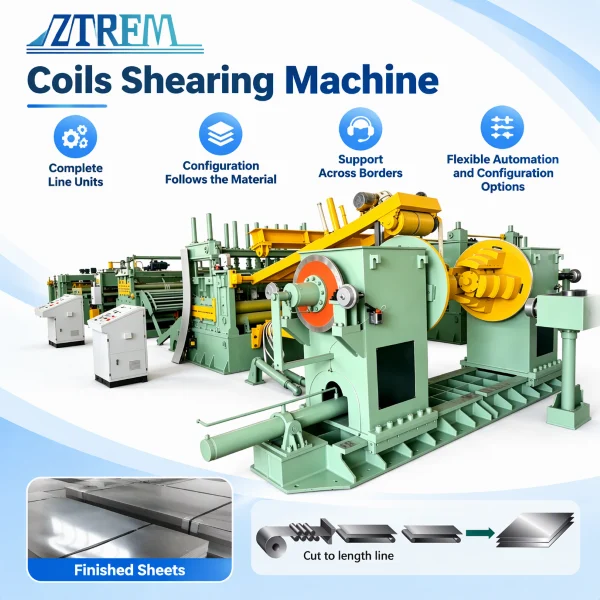
‹ › Choosing a cut to length machine line isn't just about chasing the highest line speed. What really matters is how well the whole setup, from loading and uncoiling through leveling, shearing, conveying and stacking, fits the coil you actually run. We'll go through how this line is built, how it gets matched to…
Contact: Elliot liu
Email: [email protected]
WhatsApp: 008615127728988
Detailed Content
Choosing a cut to length machine line isn't just about chasing the highest line speed. What really matters is how well the whole setup, from loading and uncoiling through leveling, shearing, conveying and stacking, fits the coil you actually run. We'll go through how this line is built, how it gets matched to your requirements, and where the key numbers sit.
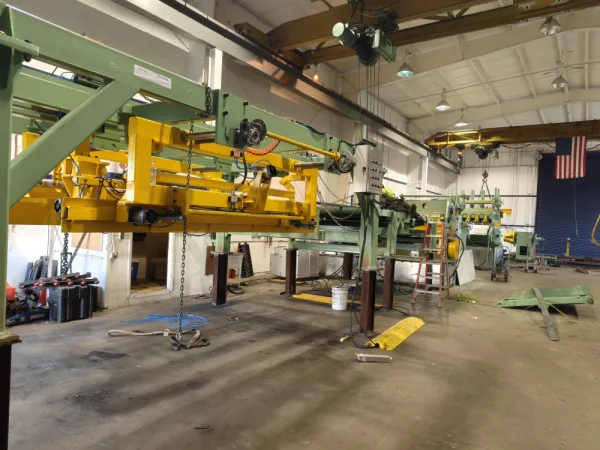
A full line isn't a single machine. It's a sequence of sections, each with its own job, running from coil entry to stacked sheet exit. The process runs like this.
A hydraulic coil car lifts the coil and moves it onto the mandrel, with both horizontal travel and lifting action, rated at 25 tons. Behind it sits a hydraulic double head uncoiler with expanding mandrels, brakes and stepped coil support discs. The twin head layout lets the next coil be positioned while the current one runs, which helps shorten changeover prep time.
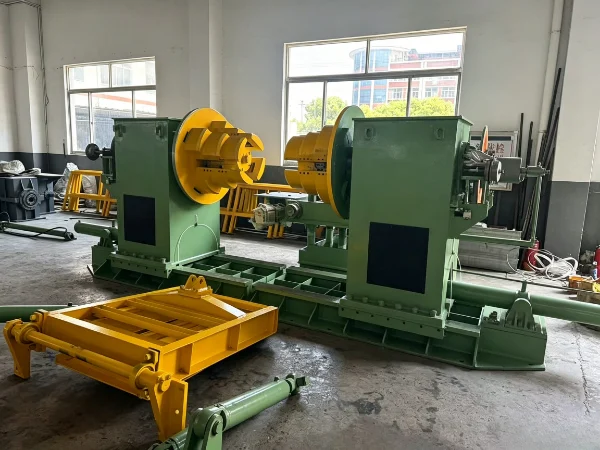
The strip first goes through a four high leveler with 17 leveling rolls, 4 sets of support rolls, 2 pinch rolls, all at 85 mm roll diameter, driven by a 110 kW DC motor. This pass takes out most of the coil set. The strip then enters a strip accumulator, where photo eyes work with the PLC to balance speed between the uncoiling and processing sections. A vertical roll side guide, adjusted by hand, keeps the strip tracking on centre. This is the rough pass; the fine pass happens downstream.
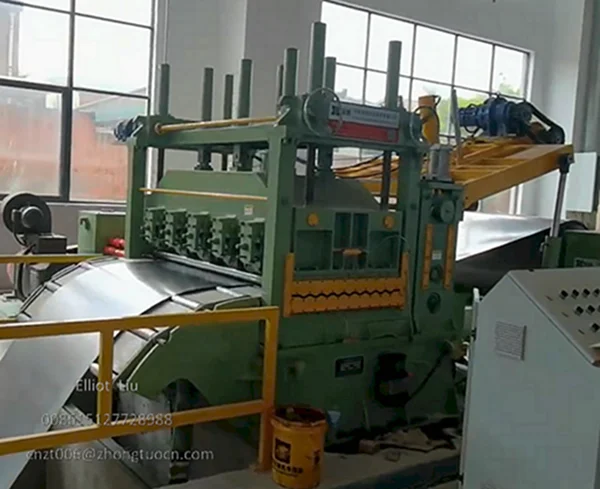
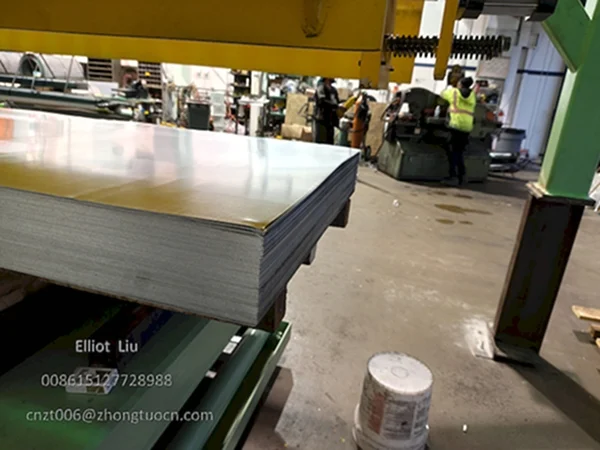
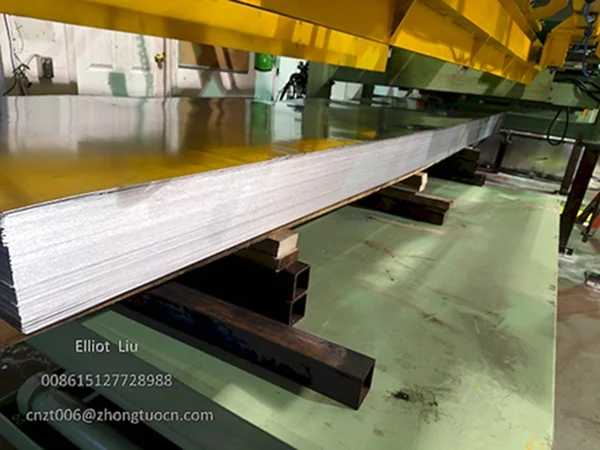
The shear is a guillotine type with a bottom up cutting action, using LD alloy steel blades in a four sided structure. Cut sheets drop onto a belt conveyor driven by a 4 kW variable speed motor. At the end sits a hydraulic lift table with a receiving length of 1000 to 4000 mm and a width range of 500 to 1830 mm. The table lowers as the pile builds, which helps keep the drop height steady and reduces the chance of sheets knocking against each other.
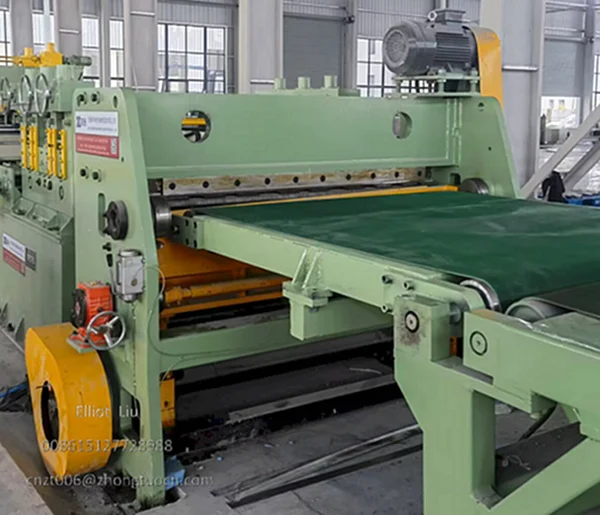
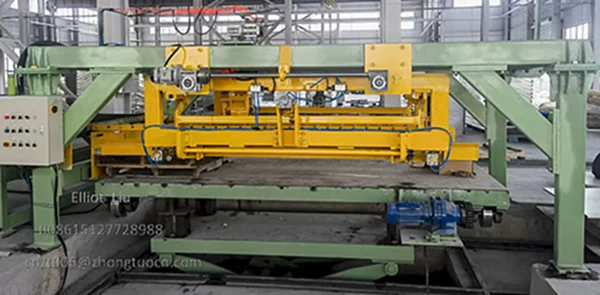
The stacker uses pneumatic squaring fingers, with PLC controlled lowering on the table side, to align the sheets to form orderly stacks. An outfeed trolley on rails then carries the stack out of the line for strapping and handling. Underneath it all sit the pneumatic, hydraulic and electrical systems, run from a centralized touchscreen console with a monitoring camera, so every section moves in step.
Buying a cut to length machine line isn't about picking the fastest spec on paper. It's about whether the whole configuration lines up with the coil you run and the sheet you need out the other end. Two checks matter most.
Start with what you actually process. Grade, thickness, tensile and yield strength, width and coil weight all point to different uncoiler mandrel ranges, leveler roll layouts and shear capacities. Carbon steel at 0.5 to 3.5 mm and stainless at 0.5 to 1.5 mm, for example, pull the leveler setup in different directions. Coil weights up to 25 T also set what the coil car and mandrel need to handle. Miss this and the rest won't catch up.
If your orders call for tight length tolerance and square diagonal, the precision leveling unit, the measuring feed rolls and the shear have to work as a set. Length accuracy of ±0.5 mm at L 2 m and diagonal accuracy of ±1 mm come from that chain, not from the shear alone. The coarser the tolerance you can accept, the more room you have to simplify the upstream leveling. Tell us your tolerance and we'll tell you which leveling config actually earns its keep.
| Section | Item | Value |
|---|---|---|
| Whole line | Control type | PLC and DC control |
| Material | Plain carbon steel and stainless steel, excluding black coil | |
| Carbon steel thickness | 0.5 to 3.5 mm | |
| Stainless steel thickness | 0.5 to 1.5 mm | |
| Material width | 500 to 1830 mm | |
| Tensile strength | δb ≤ 450 MPa | |
| Yield strength | δS ≤ 260 MPa | |
| Coil inner diameter | Φ508 / 610 / 760 mm | |
| Coil outer diameter | ≤ Φ2000 mm | |
| Coil weight | ≤ 25 T | |
| Line speed | ≤ 60 m/min | |
| Length accuracy | ≤ ±0.5 mm at L 2 m | |
| Diagonal accuracy | ≤ ±1 mm at L 2 m | |
| Leveling accuracy | ±1 mm | |
| Power supply | 480 V / 3 PH / 60 Hz, customizable | |
| Line direction | Right to left, console facing the line | |
| Loading and uncoiling | Hydraulic coil car | 25 T load capacity |
| Double head uncoiler | Hydraulic expanding mandrel, brake, stepped support discs | |
| Leveling unit | Leveling rolls | 17 |
| Support rolls | 4 sets | |
| Pinch rolls | 2 | |
| Roll diameter | Φ85 mm | |
| Main motor | 110 kW DC | |
| Strip accumulator | Accumulator type | Photo eye with PLC speed coordination |
| Side guide | Guide type | Vertical roll, width 500 to 1830 mm, manual adjust |
| Precision leveling unit | Configuration | Five rolls, 2 upper and 3 lower |
| Servo motor | 22 kW | |
| Pinch and measuring feed rolls | 4 | |
| Shearing unit | Shear type | Guillotine, bottom up cutting |
| Blade | LD alloy, four sided | |
| Conveying and stacking | Conveyor motor | 4 kW variable speed |
| Hydraulic lift table | 1000 to 4000 mm length, 500 to 1830 mm width | |
| Pneumatic stacker | 3 × 0.75 kW motors for width and length adjustment | |
| Outfeed trolley | Rail driven | |
| Pneumatic system | Working pressure | 0.5 to 0.8 MPa |
| Air supply | 1 m³/min at compressed state, source by user | |
| Hydraulic system | Working pressure | 6.3 to 16 MPa |
| Electrical system | Control | Centralized control, touchscreen operation, monitoring camera |
So how do you tell whether a coils shearing machine really fits your cut to length job? Don't score it line by line against a spec sheet. Look at whether the build logic matches how your shop actually runs.
Send us your grade, thickness, width, cut length, output style and budget, and we'll map out which units carry over and which need rethinking. That gives you a coils shearing machine setup that fits the way you work, instead of one that only looks good on paper.
Contact: Elliot liu
Email: [email protected]
WhatsApp: 008615127728988
Contact Us For More Roll Forming Machine Detailed Information
You can contact us either through phone number 0086-15127728988 within our working hours, or send an email to [email protected], or send an inquiry form to us using "Inquiry Now" option. Our customer representatives will respond as soon as possible.