METAL ROLL FORMING MACHINE
Zhongtuo roll forming Systems is a "one-stop shop" for all your roll forming needs,enabling our customers to save time and money when buying roll forming machines,to help customers grow.

Zhongtuo roll forming Systems is a "one-stop shop" for all your roll forming needs,enabling our customers to save time and money when buying roll forming machines,to help customers grow.
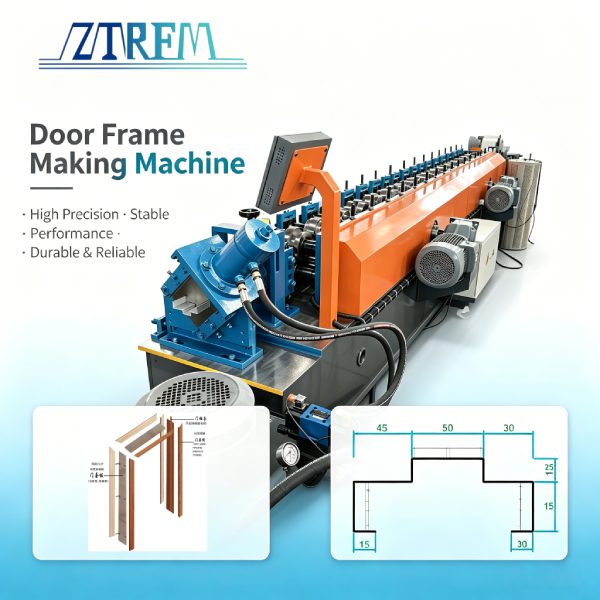
This article provides a complete overview of the door frame roll forming line. It explains the five workstations, the continuous material flow, and the technical advantages that ensure consistent quality and production efficiency.
Contact: Elliot liu
Email: [email protected]
WhatsApp: 008615127728988
Detailed Content
The door frame manufacturing industry is moving from standalone machine operation to integrated production lines. Traditional segmented processing involves excessive material handling, frequent manual intervention, and inconsistent dimensional accuracy. These limitations directly reduce factory delivery capacity and profit margins.
A well designeddoor frame roll forming linemust cover the full process from coil to finished product. Each workstation must also achieve smooth material transfer and balanced cycle times. This is where an integrated line offers clear value over a collection of separate machines. The automatic speed adjustment for decoiler serves as the entry point that feeds material into this complete production system.
This article traces the complete physical flow of steel coil from the workshop entry point to finished product stacking. It examines the workstation layout, the transfer logic between stations, and the control principles that govern the line. The goal is to help you establish a clear understanding of this complete equipment system.
The production line adopts a modular segmented design with all workstations arranged in a straight line. Steel coil enters from one end, and finished door frames exit from the opposite end.
The automatic speed adjustment for decoiler pulls the steel coil forward without active motor drive. This passive method ensures the material enters the leveling section under consistent tension. Material transfer between workstations uses a continuous pass through method with no manual handling or intermediate storage. The compact line layout covers approximately 9 square meters (7500 x 1200 mm), making it suitable for standard workshop installation conditions.

The steel coil starts at the decoiler and moves through leveling, roll forming, shearing, and output across five workstations before becoming individual door frames. The material flow follows a straight through path with no manual handling between stations.

The specific production sequence is as follows:
Each workstation in this sequence performs a dedicated function. The automatic speed adjustment for decoiler regulates the feed rate to match the main machine consumption. Material transfer between workstations uses a continuous pass through method. No manual handling or intermediate storage is required between stations. The compact line layout covers approximately 9 square meters (7500 x 1200 mm), making it suitable for standard workshop installation conditions.
The design philosophy behind this line goes beyond simply connecting workstations. This equipment delivers systematic improvements in three dimensions: smooth material flow, control precision, and equipment service life.
The decoiler uses a passive pull method and relies entirely on the main machine to draw the steel coil forward. This approach avoids the stretching damage that active motor starts and stops can cause on thin sheets. The passive method protects the galvanized layer and the coating surface from scratches and marks. The automatic speed adjustment for decoiler accommodates coil inner diameters from 450 to 550 mm, a maximum width of 300 mm, and a load capacity of 3 tons.

The 17 roller stations use gearbox driven synchronization. This ensures that every station maintains exactly the same linear speed across the entire line. Speed differences between stations would create internal stress within the profile and cause bending or twisting after release. The gear transmission effectively eliminates this risk.

The machine frame uses a memorial arch style closed structure with 25 mm thick plates and a total weight of 4.5 tons. This substantial mass provides inertial damping that absorbs high frequency vibration generated during roll forming. The result is consistent profile dimensions even at high production speeds.

The roller material is GCr12 bearing steel, which achieves hardness and wear resistance comparable to SKD11 grade. Ordinary die steel tends to develop adhesive wear on the surface during continuous production and causes scratching on the sheet surface. This material selection effectively extends roller life and preserves sheet surface quality. The automatic speed adjustment for decoiler works in harmony with these durable components to maintain stable material flow throughout the production run.

An encoder mounted on the main machine output shaft collects pulse signals in real time. The PLC triggers the shearing command immediately when the preset length is reached. This closed loop system maintains the length tolerance at ±1.0 mm for 3 meter sections. The finished frames arrive at the construction site without requiring secondary cutting.

The door frame profiles produced by this line are suitable for the following construction scenarios:
The line processes three material types: GI (galvanized iron), low carbon steel, and cold rolled steel. The thickness range covers 1.0 to 1.5 mm. This flexibility meets the material selection requirements for both standard construction and fire rated applications. The automatic speed adjustment for decoiler handles all these material types without requiring adjustment between coil changes.


| Parameter | Specification |
|---|---|
| Number of roller stations | 17 passes |
| Roller material | GCr12 (equivalent to SKD11 grade) |
| Shaft diameter | 60 mm |
| Shaft material | 45# steel, tempered |
| Frame structure | Middle plate welded, memorial arch design |
| Frame plate thickness | 25 mm |
| Machine weight | Approx 4.5 tons |
| Main motor power | 7.5 kW x 2 units |
| Drive method | Gear transmission |
| Forming speed | 0 to 20 m/min |
| Decoiler load capacity | 3 tons |
| Decoiler inner diameter range | 450 to 550 mm |
| Decoiler maximum width | 300 mm |
| Material thickness range | 1.0 to 1.5 mm |
| Material types | GI, low carbon steel, CR steel |
| Hydraulic station power | 5.5 kW |
| Shear blade material | GCr12, quenched |
| Length tolerance | 3 m ±1.0 mm |
| Hydraulic oil grade | 46# |
A complete door frame roll forming line delivers more than just workstation connectivity. This equipment provides systematic optimization across material utilization, product consistency, and delivery lead time.
When these system designs work together, the factory achieves measurable improvements in overall production efficiency.
Please contact us to discuss configuration options that match your specific material specifications and production targets.
Contact: Elliot liu
Email: [email protected]
WhatsApp: 008615127728988
Contact Us For More Roll Forming Machine Detailed Information
You can contact us either through phone number 0086-15127728988 within our working hours, or send an email to [email protected], or send an inquiry form to us using "Inquiry Now" option. Our customer representatives will respond as soon as possible.