METAL ROLL FORMING MACHINE
Zhongtuo roll forming Systems is a "one-stop shop" for all your roll forming needs,enabling our customers to save time and money when buying roll forming machines,to help customers grow.
Zhongtuo roll forming Systems is a "one-stop shop" for all your roll forming needs,enabling our customers to save time and money when buying roll forming machines,to help customers grow.
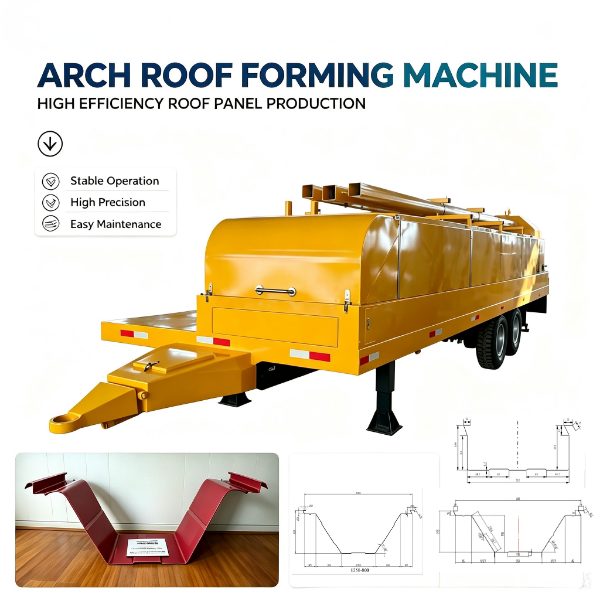
Learn how the arch roof forming machine improves material utilization and optimizes panel design to lower production costs and prevent roof leaks. Compare three models: 305, 680 and 800.
Contact: Elliot liu
Email: [email protected]
WhatsApp: 008615127728988
Detailed Content
You work on roofing projects. Two things worry you the most: wasting too much steel coil and dealing with roof leaks.
Material costs take up sixty to seventy percent of your total expenses. Every inch of wasted steel cuts straight into your profit. And when a roof leaks, repair bills go up and your client's trust goes down.
Thisarch roof forming machinesolves both problems at once. This article focuses on its strengths in material utilization and panel waterproofing design. You will also see how three models match different project needs.
Have you ever calculated how much finished product you actually get from each coil of steel?
Material utilization directly affects your production cost. Every percentage point you gain in utilization adds up to real savings over time.Our 305 model arch roof forming machine achieves 51% material utilization. The 680 model reaches 68%. The 800 model delivers 64%.With the same coil of steel, the 680 model gives you nearly twenty percent more finished product than the 305 model. That is pure profit.
High utilization comes from optimized panel design. Our machine uses precise roller arrangement and forming simulation. Every millimeter of steel that enters the machine becomes usable roofing material as much as possible. Narrower trim edges mean less scrap. Your steel coil purchases go further.
Different models match different feed widths. The 305 model takes 600mm coil. The 680 model takes 1000mm coil. The 800 model takes 1250mm coil. You can choose the most economical setup based on the coil sizes available in your local market.

Have you ever dealt with roof leaks on windy days?
The problem is often not the installation. It is the panel profile. If the groove is not deep enough, water does not drain well. Wind blows it back under the panels.
Our 800 model arch roof forming machine produces panels with a 320mm groove depth. This depth allows smooth drainage and creates more reliable overlap between panels.Panel profile directly affects waterproofing. The seam on a single rib panel sits at the highest point of the rib. It overlaps tightly and resists wind driven rain. Our machine uses forming stations designed around this principle. Each panel comes out with a precise cross section and tight interlocks.
The 305 and 680 models also use optimized panel designs. The exact groove depth may vary by profile, but the waterproofing logic stays the same: enough rib height, tight overlaps, and fast water runoff.


Roller and blade materials also affect forming quality. All three arch roof forming machines use 45# steel rollers with chrome plating. The blades are made of Cr12Mov type tool steel with heat treatment. These materials maintain panel precision over time. Wear won't change the panel shape or loosen the overlaps.


Beyond standard roof panels, our machines can produce many other cross sections. Different projects need different rib heights, groove depths, and effective widths. A poultry barn uses one profile. A grain silo needs another. A gymnasium calls for something different. If you have a specific profile in mind, send us the drawings and we will evaluate the feasibility.
| Parameter | 305 Model | 680 Model | 800 Model |
|---|---|---|---|
| Maximum span | 26 m | 36 m | 42 m |
| Effective width | 305 mm | 680 mm | 800 mm |
| Feed width | 600 mm | 1000 mm | 1250 mm |
| Thickness range | 0.6-1.6 mm | 0.5-1.6 mm | 0.8-1.5 mm |
| Groove depth | — | — | 320 mm |
| Material utilization | 51% | 68% | 64% |
| Total weight | Approx. 8 T | Approx. 10 T | Approx. 13 T |
| Straight sheet speed | 15 m/min | 15 m/min | — |
| Arch sheet speed | 13 m/min | 13 m/min | 13 m/min |
| Seaming speed | 10 m/min | 10 m/min | 6 m/min |
| Roller material | 45# steel, chromed and quenched HRC58-62 | 45# steel, chromed and quenched HRC58-62 | 45# steel with chrome plating |
| Shaft material | 45# steel, adjusted | 45# steel, adjusted | — |
| Roller stations | 13+2 | 13+2 | — |
| Blade material | Cr12MoV with heat treatment | Cr12Mov with heat treatment | Cr12Mov |
| Total power | 16.7 KW | 16.7 KW | — |
| Drive system | Electric motor | Electric motor | Full hydraulic + 40HP diesel engine |
| Electrical standard | 380V/60Hz/3 phase | 380V/60Hz/3 phase | — |
| Machine size (LxWxH) | 8800x2200x2080 mm | 9500x2270x2400 mm | 10000x2250x2200 mm |
| Special features | — | — | Detachable bending section; two axles with 8 tires; H type steel frame |
You might wonder whether the panel profile will stay consistent after years of use.
Forming precision depends on machine rigidity. The 305 model weighs about 8 tons. The 680 model weighs about 10 tons. The 800 model reaches 13 tons. Weight gives you stability. A heavy machine does not vibrate at high speed, so panels come out straight.
Roller stations also matter. The 305 and 680 arch roof forming machines use a 13 plus 2 station configuration. That is 13 forming stations plus 2 sizing stations. This setup allows gradual deformation with low residual stress. Panels hold their shape and do not spring back.
The 305 and 680 models use Siemens PLC controls. The interface is clean and adjustments are straightforward. When you switch between thin and thick steel, just change the number on the control screen and keep running.


The 305 model works for projects within 26 meters, like standard factories and barns. Its thickness range is 0.6 to 1.6 millimeters.
The 680 model covers spans up to 36 meters. It has the highest material utilization at 68% among the three models. Thickness starts at 0.5 millimeters. This model fits logistics warehouses and large workshops.
The 800 model reaches 42 meters. It comes with a two axle chassis, 8 tires, and a diesel engine. This makes it suitable for job sites that change often or locations without three phase power. Its 320mm groove depth was designed specifically for projects with high waterproofing requirements.
If you are not sure which model fits your needs, tell us your typical project span, coil width, and site conditions. If you have a custom profile in mind, send us the drawings and we will take a look.
We are always available to offer recommendations based on your specific requirements.
Contact: Elliot liu
Email: [email protected]
WhatsApp: 008615127728988
Contact Us For More Roll Forming Machine Detailed Information
You can contact us either through phone number 0086-15127728988 within our working hours, or send an email to [email protected], or send an inquiry form to us using "Inquiry Now" option. Our customer representatives will respond as soon as possible.