METAL ROLL FORMING MACHINE
Zhongtuo roll forming Systems is a "one-stop shop" for all your roll forming needs,enabling our customers to save time and money when buying roll forming machines,to help customers grow.

Zhongtuo roll forming Systems is a "one-stop shop" for all your roll forming needs,enabling our customers to save time and money when buying roll forming machines,to help customers grow.
Contact: Elliot liu Email: [email protected]: 008615127728988
Contact: Elliot liu
Email: [email protected]
WhatsApp: 008615127728988
Detailed Content
Have you ever faced this problem? Orders come in but you hesitate to accept them because you don't have enough workers or time.
Many shops still use the old way: punching, shearing, bending, welding, and moving materials around. Five or six workers run several separate machines. When orders pile up, things get messy. Dimensions go off and you have to rework. Clients push for faster delivery while your team gets exhausted.
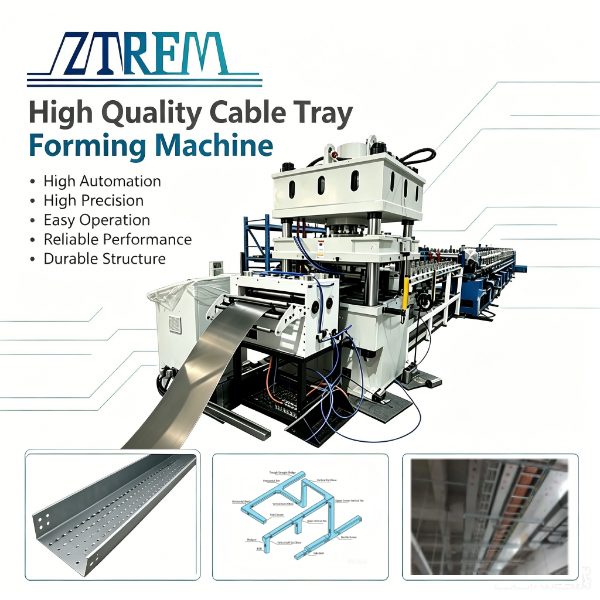
Thishigh quality cable tray forming machineconnects uncoiling, punching, forming, cutting, and expanding into one single production line. One person runs the machine, another collects the finished products. In two hours, you get what used to take a full day. Length tolerance stays firmly within plus or minus one millimeter.
•Electrical wiring systems in commercial buildings
•Power and control cable installation in industrial plants
•Cable tray installation inside power substations
•Cable management in data center server rooms
•Cable channels along rail transit lines
•Corrosion resistant tray production for chemical and energy projects
•Standardized wiring for light industry and textile workshops


Forming precision determines whether trays fit together smoothly on site. This equipment uses 30 roller stations for progressive forming.
The main shaft diameter is 65 mm, paired with Cr12 roller material. This ensures dimensional stability during high volume production. When rolling 2.0 mm thick sheets, the angle tolerance stays within 90 degrees plus or minus 2 degrees.

Is investing in an automated production line worth it? Every factory owner does this math.
Take 1000 meters of 300 by 80 mm trays as an example. The traditional method requires punching, shearing, bending, welding, and material handling. That is five separate steps, at least five workers, eight hours of work time, and accumulated errors up to plus or minus 3 mm.
This line integrates feeding, punching, forming, and expanding into one continuous flow. It needs only two operators and two hours to finish the same quantity. Length tolerance stays stable at plus or minus 1 mm.
Labor cost drops by more than half. Equipment investment typically pays back within 12 to 18 months, depending on local wages and order volume.


Uncoiler → Servo feeder → Punch press (punching) → Cutting → Conveying table → Forming → Servo tracking expansion → Discharge

This production line combines uncoiling, feeding, punching, cutting, forming, and expanding into one continuous operation. A PLC system controls the entire process automatically. Only two operators are needed to complete all production from steel coil to finished trays. The highly automated design greatly reduces manual intervention while ensuring consistent dimensional accuracy across every batch.
Cable tray specifications and electrical standards vary across countries and regions. Thishigh quality cable tray forming machinesupports multiple customizations based on customer needs.
Voltage options include 380V/50Hz, 460V/60Hz, or other levels. The control interface supports English, Spanish, Arabic, and other languages. Equipment color can be painted to match your factory's standard scheme.
Forming speed is adjustable. Punching force and cutting length can both be programmed. Rollers and dies are manufactured separately according to customer drawings.Changeover time is controlled within 30 minutes. Small batch, multi variety production is no longer a challenge.

| Parameter | Range |
|---|---|
| Strip width range | 220 to 850 mm |
| Strip thickness range | 0.5(±0.03) to 2.0(±0.03) mm |
| Product bottom width | 100 to 600 mm |
| Product side height | 50 to 100 mm |
| Product length | 2000 to 6000 mm |
| Length tolerance | ±1 mm |
| Angle tolerance | 90° ± 2° |
| Production speed | 6 to 12 m/min (adjustable) |
| Number of forming stations | 30 |
| Main shaft diameter | 65 mm |
| Roller material | Cr12 |
| Press tonnage | 400 tons (hydraulic) |
| Floor space | 38 × 2.0 × 2.0 m (L × W × H) |
Core components come from well known brands. The Mitsubishi PLC system pairs with a touchscreen for intuitive operation and multi language support. The press is a 400 ton Yangli hydraulic machine, with die steel made of Cr12MoV. Cutting tolerance is controlled within plus or minus 1 mm.
We offer voltage adaptation services for overseas customers. The standard configuration is 380V/50Hz three phase, with 60Hz or other voltage levels available on request.
Consumable parts like punches, dies, and rollers are kept in stock for fast shipping. The full line comes with a 12 month warranty, during which remote technical support is provided.

If you are planning a new workshop or considering an upgrade to existing equipment, we can offer a customized solution based on your specific product drawings and output requirements. Feel free to reach out anytime to discuss the production configuration that works best for you.
Contact: Elliot liu
Email: [email protected]
WhatsApp: 008615127728988
Contact Us For More Roll Forming Machine Detailed Information
You can contact us either through phone number 0086-15127728988 within our working hours, or send an email to [email protected], or send an inquiry form to us using "Inquiry Now" option. Our customer representatives will respond as soon as possible.